When was the last time your child regularly watched you cook at home?
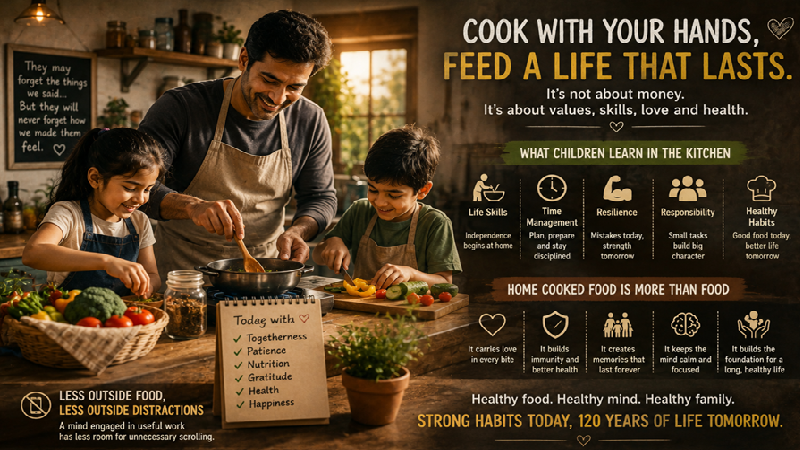
Not on a festival day. Not on a special occasion. Just on an ordinary weekday — a small pot on the stove, vegetables on the cutting board, your hands moving without rush.
It is a small question. But it opens a quieter one — what does a child really receive from food that is prepared by their own parents?
This is not a reflection against restaurants, deliveries, or convenience. Each has its honest place in modern life. This is only a soft pause to look at what may be slowly forming inside our homes, across generations, when the kitchen begins to fall silent.
Is cooking only about eating — or also about learning life?
Food fills the stomach. But cooking, perhaps, fills something else.
When a child sees raw rice, a few vegetables, some spices, water, fire — and slowly watches them become a meal — something simple but deep is being shown. That ordinary things, given time and care, become something nourishing. That patience has a result. That preparation precedes everything good.
A delivery app gives a child the finished dish. A home kitchen gives the child the whole story behind it.
What happens inside a child who quietly watches a parent cook?
Children may not be able to put it into words. But they are observing.
- They see ingredients turning into meals — and understand that nothing real arrives instantly.
- They observe patience — the chopping, the waiting, the stirring, the cleaning afterwards.
- They learn small responsibility — passing a spoon, washing a plate, watching the flame.
- They sense care — that someone, for the next twenty minutes, is preparing something only for them.
None of this is announced. It simply enters them, day after day, the way light enters a room without asking permission.
If a child has rarely seen a meal being made — only meals arriving — what kind of relationship with food are they slowly building?
The quiet life skills a kitchen may teach
A kitchen is one of the oldest classrooms in any home. It does not give marks. But it shapes something deeper than marks.
A child who occasionally helps in the kitchen may, without realising it, be picking up:
- Resilience — small mistakes, burnt edges, broken eggs, and learning to try again.
- Time management — knowing that rice takes one duration, vegetables another, and that hunger does not stop the clock.
- Responsibility — that what they touched, they will also clean.
- Self-dependence — the quiet confidence that one day, if alone, they can feed themselves with dignity.
- Awareness of ingredients — what is fresh, what is processed, what feels right in the body.
These are not subjects on any syllabus. But they are the soft tools of an adult life that does not collapse easily.
When the hands are busy, where does the mind go?
There is something to notice here, gently.
When a person is genuinely engaged in real work — cutting, kneading, stirring, washing — the mind tends to settle. There is a small task in front, and the attention naturally rests on it. The hands are full. The mind is, for a few minutes, not wandering.
What happens in a home where children rarely have such moments? Where every gap in the day is quickly filled by a screen, a scroll, a video, a notification?
Could a small amount of real, slow, hands-on work in the kitchen quietly become a kind of break from the endless mental wandering of the digital world?
When children's hands are engaged in something real, does the pull of the screen become a little softer?
Outside food culture — not right or wrong, but a pattern
It is not useful to label outside food as good or bad. Most families enjoy a meal out, an occasional order, a celebration at a restaurant. That is part of life.
The honest question is different. It is not about one meal. It is about a pattern that may be slowly forming across years.
When most weekday dinners come in a packet. When breakfasts are picked up on the way. When children grow up tasting more of factories and kitchens of strangers than of their own home — what habits are quietly being passed forward?
And what kind of food memory will they carry into their own adulthood, into their own parenting, twenty or thirty years from now?
Can food carry something beyond nutrition?
Nutrition labels can be measured. Something else cannot.
Food prepared by a parent often carries a quiet additional layer — attention, care, calmness, the unspoken sense of being looked after. A child rarely names this. But the nervous system seems to notice. There is a difference between a meal eaten alone from a box and a meal placed in front of you by someone who knows how you like it.
It is hard to prove. But many adults, decades later, can still recall the smell of a particular dish from childhood — and what they feel when they recall it is not hunger. It is something closer to safety.
What children may quietly learn through home cooking
- Patience
- Responsibility
- Simplicity
- Family participation
- Healthy food awareness
- Respect for what is on the plate
- The quiet rhythm of an ordinary day
None of this needs a speech. It is absorbed slowly, simply by being in a home where cooking happens.
Children remember how life was lived at home
Twenty years from now, a child may not remember most of what was said to them. But they will remember the texture of the home they grew up in.
Whether the kitchen was alive or quiet. Whether mornings carried the smell of something being prepared, or only the sound of doors closing. Whether they ever stood beside a parent at a stove and learned, without lessons, that someone cared enough to feed them by hand.
These memories are not loud. But they shape what "home" means inside them — long after they leave it.
Home cooking and the long road of 100–120 years
A life that gently reaches 100–120 years is rarely built on extraordinary things. It is more often built on simple ones, repeated for decades.
- Simpler food patterns — fewer extremes, more freshness.
- Self-dependence — knowing how to feed oneself without depending only on outside hands.
- Reduced stress — the quiet calm of an unhurried meal at home.
- Consistent family routines — meals at roughly the same time, around roughly the same table.
Perhaps a long life is not engineered in clinics. Perhaps it is built quietly in ordinary daily acts — like chopping vegetables, watching a pot, sitting down together for a few unhurried minutes.
Healthy generations may begin in the kitchen — long before hospitals and medicines ever become necessary.
A gentle close
None of this is meant to add guilt to already full days. Modern life is genuinely demanding. Not every meal can be cooked at home. Not every parent has the same hours or energy. That is real, and it is honest.
This is only a quiet invitation to notice — across an ordinary week, how often do our children see a meal being made by hand? How often do they stand close, watch, help, and eat something prepared with care?
If children grow into adults without learning basic life skills — without knowing how to feed themselves simply, patiently, with awareness — what kind of adulthood will they face?
And what memories of home will stay with them, decades later, when life becomes their own to carry?
Why not 100?
Why not 120?
Perhaps it begins with what is prepared… by hand, at home.