What do children remember most from their childhood?
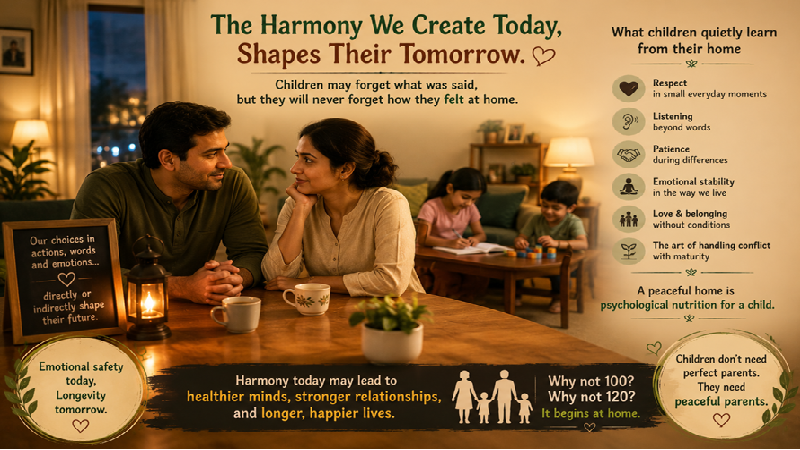
Years from now, when our children sit somewhere in their own quiet evenings and look back, what will they remember first?
Will they remember the words we said to them? The lessons we tried to teach? The advice we carefully prepared?
Or will they remember something softer, harder to name — the feeling of the home itself? The way two people lived with each other under one roof?
Do children remember what parents said… or how parents lived with each other?
Every family has differences
No home is without disagreement. Two people, raised in two different families, with two different histories, two different temperaments, two different ways of seeing the world — they will not always agree.
That is not a failure. That may simply be the nature of marriage and family life.
So perhaps the quiet question is not whether disagreements exist.
Is disagreement itself the problem? Or is it the way disagreements are lived and expressed?
One home may have many differences and still feel calm. Another may have fewer differences and still feel heavy. What makes the difference?
Children are quietly observing
Children rarely sit and analyse their parents. They simply absorb.
They notice things adults often forget they are doing:
- The tone of voice used at the dinner table
- Whether respect remains even during disagreement
- How patience appears — or disappears — under stress
- The small reactions that pass between parents in a single day
- The everyday way one person speaks about the other, even in their absence
None of this is taught with words. It is taken in silently, year after year, until it becomes the inner landscape of a child's mind.
If we knew how closely our children were watching the way we treat each other, would something quietly change in our daily behaviour?
Children do not need parents who never disagree. They may simply be watching how disagreement is handled when it arrives.
The long horizon during a short moment
In the middle of a tense evening, when words rise quickly and patience runs thin, very few thoughts seem to fit in the mind.
But a quieter question may sometimes return:
What is this moment teaching our children?
Not what we plan to teach them tomorrow. Not what we say in calmer hours. But this — right now — the tone, the words, the reactions, the silence afterwards.
If a single evening leaves an impression that lasts for years, then what kind of impression is being formed across thirty, fifty, or one hundred years of family life?
What do children inherit?
It is easy to think of inheritance as something written on paper. Property. Savings. A name. A house.
But there may be another inheritance, quieter and more powerful, passed from one generation to the next without any document.
- Emotional patterns — how to feel, how to react, how to recover
- Relationship habits — how a husband speaks to a wife, how a wife speaks to a husband
- Stress responses — what to do when life becomes difficult
- Ways of handling conflict — through silence, through shouting, through honesty, through avoidance
- The unspoken sense of whether home is a safe place or a tense one
Children do not have to be told any of this. They live inside it. And one day, often without noticing, they begin to repeat it in their own homes.
If our children carried forward exactly the relationship patterns they see in our home today, what would the next generation's marriages look like?
A peaceful home as quiet nourishment
We speak so often about food. Clean water. Sleep. Exercise. The known foundations of a healthy life.
Could there be another foundation, less visible, just as important?
Can a peaceful home become a kind of psychological nutrition for a growing child?
A child who eats well but lives in constant tension — what kind of nervous system are they slowly building?
A child who lives in a calm, respectful home, even with ordinary disagreements — what kind of inner steadiness are they quietly developing?
None of this can be measured in a single check-up. But over many years, it may shape the body just as much as the food on the plate.
What may children quietly learn at home?
Without any classroom, without any lecture, without any reminder, children may be learning lessons that stay with them for life:
- Respect — how to give it, how to expect it, how to recognise its absence
- Patience — whether it is normal to pause, or normal to react
- Listening — whether voices are heard, or only managed
- Emotional stability — whether feelings have a safe place at home
- Conflict resolution — whether problems are solved, suppressed, or allowed to grow
These are not small things. They may quietly decide how a child handles their own marriage decades from now. How they raise their own children. How they manage their own stress when life becomes heavy.
What kind of family culture will our children carry into their own marriages, their own homes, their own children's childhoods?
Family harmony and the long life
A life that reaches 100 or 120 years is rarely built only on what is eaten or how often the body moves.
It may also rest, quietly, on something less spoken about:
- Emotional stability across decades
- Reduced chronic stress in the everyday environment
- Strong, dependable family relationships
- A sense of psychological safety inside the home
If a child grows up inside calmness, their body may carry less hidden tension into adulthood. If a child grows up watching respect, they may build relationships that protect them in old age. If a child grows up inside emotional safety, they may meet life's storms without breaking inside.
Perhaps one of the greatest gifts parents can offer is not only education, or money, or opportunities — but a stable emotional environment to grow up in.
Family harmony may quietly become one of the invisible foundations of long-term health across generations.
Not perfection — only awareness
None of this is a demand for a flawless home. There will be tired evenings. There will be sharp words that should not have been spoken. There will be misunderstandings that take days to settle.
That is the honest texture of family life.
It is only an invitation to notice — gently, without blame on anyone — how the atmosphere between two adults may quietly shape the future of the small lives growing up beside them.
Not the husband's fault. Not the wife's fault. Simply a shared awareness of the home being built, day by day, between them.
A quiet close
When your children remember their home decades later, what feelings will come to mind first?
What habits of relationship are they learning from us today, without anyone teaching them directly?
If the next generation lived inside the same emotional climate we are creating right now, would we wish for them more — or less — of what we are giving them today?
Why not 100?
Why not 120?
Perhaps it begins with the peace we create… inside our own homes.