A Gentle Pause
Have you paused recently to observe how your children are growing — not just in height or weight, but in their daily rhythms, their habits, the way they spend their hours?
Not to evaluate. Not to measure against someone else's child.
Just to observe.
Because sometimes, in the pace of everyday life, we stop noticing the small things that are slowly becoming permanent patterns.
What Fills a Child's Day Today?
Think about a regular day in your child's life.
Not a holiday. Not a special occasion. Just an ordinary day.
How much of it is spent on a screen?
How much of it involves conversation — real, unhurried conversation?
How much of it is spent outdoors — not in a planned activity, but just being present in the open air?
💭 If you traced the hours from morning to night, what would the picture look like?
This isn't about judgment. It's about seeing clearly.
Where Are They Learning From?
Every child absorbs the world around them — constantly, silently.
Social media. Short videos. Online trends. The language of peers. The moods of relatives. The energy of the environment they sit in every day.
Have you ever wondered how much of your child's thinking is truly their own — and how much has been quietly shaped by what surrounds them?
Are the opinions they express coming from reflection… or repetition?
Are their preferences chosen — or absorbed?
Has living with social media quietly become the default way of growing up?
There's no need to label this good or bad. But it may be worth noticing.
What Kind of Habits Are Being Formed?
Instead of asking whether something is right or wrong, try a different question:
What is being practiced daily?
Because whatever is practiced daily — consciously or unconsciously — becomes a habit. And habits, over decades, become a way of life.
Is your child developing the ability to sit still — without a device?
Can they wait, without restlessness?
Can they focus on one thing for an extended stretch of time?
💭 The habits forming now may not show their full effect today. But in 20 or 30 years, they become the foundation of daily life.
Are They Learning to Live on Their Own?
There's a quiet dimension of growing up that rarely gets discussed in schools or even at home.
Self-dependence.
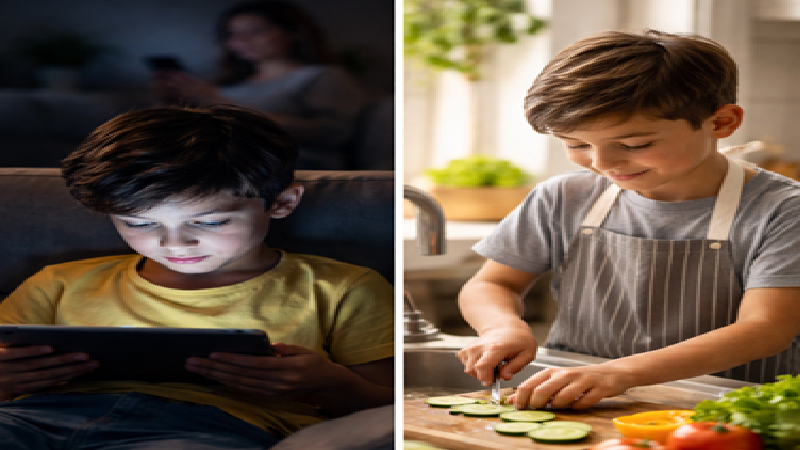
Can your child prepare a simple meal?
Can they keep their own space clean — without being told?
Do they know how to take care of themselves when no one is watching?
Can they sit through discomfort — physical or emotional — without reaching for a distraction?
These aren't tests. They're observations worth making.
Because independence isn't something that appears at 18 or 21. It begins in the small, repeated moments of childhood.
What Do Children See When They Watch Us?
Here is a truth that is simple but often uncomfortable:
Children do not follow instructions. They follow patterns.
💭 They observe how often we reach for the phone. How we react under pressure. Whether we keep our word. How we eat. How we rest. How we speak when frustrated.
They don't need a lecture on discipline. They absorb the discipline — or the lack of it — that lives around them every day.
If a child sees a parent spending hours on a screen, what conclusion do they quietly draw?
If they see impatience rewarded and calmness ignored, which pattern do they store?
This is not to blame. It is simply to notice.
Because what a child observes at home, over years, slowly becomes their definition of normal.
What Might Quietly Shape a Child's Future?
Consider this — not as a checklist, but as a lens:
- The daily habits they observe at home
- The level of independence they are allowed to develop
- Their relationship with screens and devices
- Their ability to act without constant stimulation
- The emotional steadiness — or turbulence — they grow up around
None of these appear in a report card. None of these are measured by a grade.
But each one of them may shape the kind of adult they become.
What Does This Have to Do With Living 100 or 120 Years?
A life that stretches across a full century — or beyond — does not survive on medicine alone.
It may require a strong body, built by years of movement and real food.
It may require a calm mind, trained through patience and inner stillness.
It may need the ability to live independently — to cook, to clean, to manage one's own life without constant support.
It may depend on habits formed not at 40 or 50 — but at 5 and 10 and 15.
If the foundations are not being built now, what will the structure look like in 50 years?
This is not a warning. It is a quiet invitation to look ahead.
A Moment to Sit With
If your child continues today's habits for the next 50 years, what kind of life would they build?
With the way we live today — the rhythms, the patterns, the defaults — what are we quietly preparing them for?
Not by what we say.
But by what they see. Every single day.
💭 Today's parental behavior becomes tomorrow's lifestyle blueprint — not through words, but through lived example.
There is no blame in this reflection. Only an invitation to observe — gently, honestly, without rush.
Because the children are always watching.
And they are always learning.
A Final Thought
🌿 Why not 100?
Why not 120?
Perhaps it begins with what they see… at home.
— Why Not 100 Movement 🌿