Where does discipline truly begin — at work, or at home?
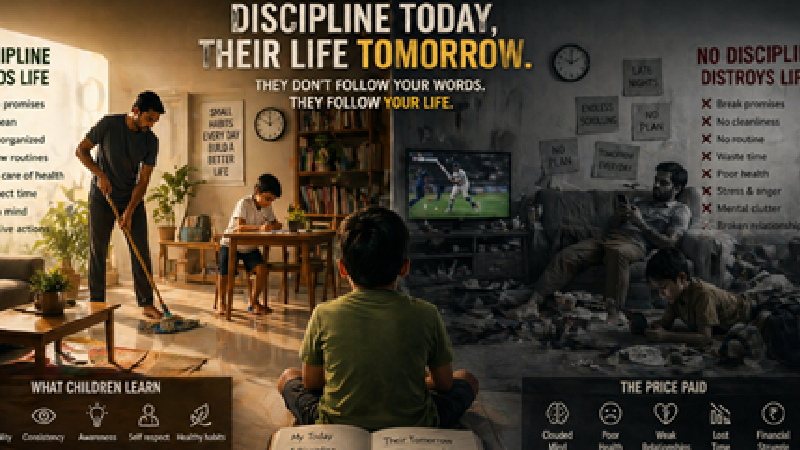
Most of us understand what discipline looks like in a workplace. Meetings begin on time. Deadlines are met. Tasks are tracked. Reports are filed. Responsibilities are taken seriously, because someone is watching.
But there is a quieter question worth sitting with.
When the office door closes behind us, where does that discipline go?
The room nobody audits
At work, structure is given to us. The day has a shape. The expectations are visible.
At home, no one is checking. There is no calendar invite for sleep. No reminder for the promise made to a child last weekend. No deadline for the corner of the room that has slowly filled with things we keep meaning to sort.
And so, slowly, two different versions of the same person can begin to exist — one careful and consistent in a meeting room, and another more relaxed, more delayed, more forgetful in the place that matters most.
Is it possible that the truer version of our discipline is the one that shows up only when nobody is observing?
If your home life were reviewed with the same attention as your work life — what would the report quietly say?
The small things that are not really small
Discipline at home rarely looks dramatic. It hides inside ordinary moments.
A promise to read a story before bed — kept, not postponed.
Shoes returned to the same place each evening. A kitchen left clean before sleep. A bed made without thinking. A morning that begins at roughly the same hour, day after day.
None of this feels important on any single day. Skipping it once changes nothing. Skipping it for years quietly changes everything.
How consistent are these small, invisible commitments in your own week?
What children actually learn
Children listen politely to instructions. They nod. They sometimes even repeat the words back.
But what they truly learn is something else.
They learn from the rhythm of the house. From the tone of the morning. From whether dinner happens around the same time each night. From whether the adult who tells them to keep their things in order keeps their own things in order.
They learn that discipline is either a thing you switch on for outsiders — or a way of being that runs quietly through every hour of life.
Which version are they growing up inside?
If your child were to describe a typical day in your home — not the words spoken, but the patterns lived — what would they say?
The blueprint we did not realise we were drawing
Children rarely build their adult life from advice. They build it from memory.
The way a parent handles a small frustration becomes the way the child, decades later, handles a much bigger one. The way a parent treats their body — what they eat, when they sleep, how they move — becomes the body the child will one day inhabit through learned habit.
The home is not just a place. It is a blueprint.
And the lines on that blueprint are being drawn every day, mostly without anyone noticing.
What may quietly build a disciplined life?
- Keeping small commitments — especially the ones made to family
- Consistent daily routines, even when no one is watching
- A clean personal space and an orderly home environment
- Calm responses instead of sharp reactions
- Daily awareness of how time, food, and attention are being spent
- Beginning and ending the day at roughly the same hour
None of these require effort that strains the body. They simply require returning to them, again and again, across years.
The quieter form of strength
There is a kind of strength that doesn't show up in conversations. It shows up in continuity.
The mind of a person who lives with steady routines is rarely scattered. The body that follows a predictable rhythm tends to recover better, sleep better, and ask for less from medicine. The emotions of someone whose home environment is calm tend to settle more easily, even on difficult days.
Is this dramatic? Not at all. Is this powerful over a lifetime? Perhaps more than we realise.
The long arithmetic of a life
A life that reaches 100 or 120 years is rarely the result of one heroic decision.
It tends to be the quiet sum of many small, consistent ones — repeated through ordinary mornings, ordinary meals, ordinary evenings, across decades.
Consistency over intensity. Stability over excitement. A balanced mind held inside a body that has been treated kindly, day after day, year after year.
Discipline, in this sense, is not a discipline of force. It is a discipline of return — the gentle willingness to come back to the same good habit tomorrow, and again the day after, without needing applause for it.
What if longevity is not built in big decisions taken occasionally — but in small actions repeated quietly, every single day, inside the home?
The mirror children become
Years from now, your children will live in a home of their own. They will keep certain hours. They will keep — or not keep — certain promises. They will treat their own bodies and their own families in a particular way.
Where will most of that have come from?
Not from a lecture. Not from a school. Not from a book.
It will come from a long, silent observation of the home they grew up inside.
If they live exactly the way you live today — not the way you advise them, but the way you actually live — what kind of life will they build?
What patterns will they remember from you, twenty or thirty years later, without ever having to be told?
A quiet close
None of this is a call to perfection. Homes are not meant to be perfect, and neither are the people inside them.
It is only an invitation to notice. To see, with calm honesty, where our discipline shows up — and where it quietly disappears the moment no one is watching.
Because the place where we are unobserved may be the place where our real life is being shaped. And the small habits practised there may be the same ones our children carry forward, long after we are gone.
Why not 100?
Why not 120?
Perhaps it begins with how we live… at home.