Is long life only for ourselves? Or is there something more quietly meaningful?
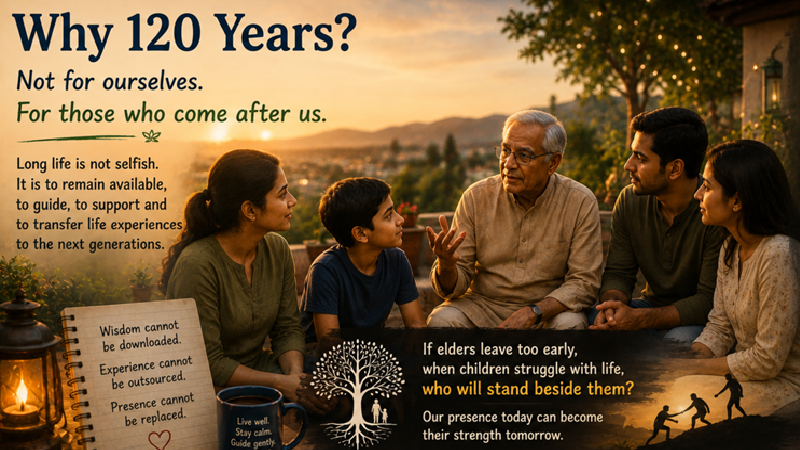
The question sounds strange at first.
Why would someone want to live 120 years?
We have built a culture where this question barely makes sense. Our media offers us the usual answers: fear of death, desire for more achievement, selfish extension of comfort.
But what if those aren't the only reasons?
What if, somewhere beneath the surface, there is a quieter answer — one that has nothing to do with fear, and everything to do with presence?
When children become adults — who stands beside them?
Think about the arc of a human life. A child grows. They learn. They face small challenges, build confidence, and eventually step into the world.
But then life gets real.
They navigate:
- Relationships that confuse, hurt, or transform them
- Family decisions that feel too large to carry alone
- Financial uncertainty — earning, saving, losing, rebuilding
- The profound weight of raising their own children
- Health challenges they never expected
- Moments of emotional collapse when nothing feels safe
In these moments — which is most of adult life — what do they really need?
Advice? Sometimes. But not usually what they're looking for.
Solutions? The world offers plenty. Apps, therapists, consultants, coaches.
What they quietly need is something much simpler: someone who has lived through it and came out steady.
Can all experience be downloaded? Can machines give perspective? Or does wisdom sometimes come from someone who has quietly lived 80, 90, a hundred years on this earth?
Modern life has new complexity
Today, the world moves faster than any generation before.
Technology reshapes industries overnight. Relationships form and dissolve through screens. Social pressure comes from strangers across the world. Economic shocks ripple globally. Information flows endlessly, and the mind struggles to process it all.
Children today face:
- Rapid technology changes they can't predict
- Economic pressure and uncertain career paths
- Social complexity across digital and physical worlds
- Constant access to curated lives of thousands of others
- Information overload that never stops
In this chaos, who teaches calmness?
Not through a lecture. Not through a TED talk. But through presence — by simply being nearby, unshaken, and available when the storms come.
Can a long life become a form of service?
Here is the quiet shift in thinking.
What if living a long life — one that reaches 100, 110, 120 years — is not primarily about you?
What if it's about remaining:
- Available — present in your family's lives when they most need steadiness
- Mentally sharp — capable of listening deeply and thinking clearly
- Physically present — able to sit beside someone, hold their hand, walk with them
- Emotionally stable — carrying calmness even in turbulent times
What if living 120 years is less about adding years to your life — and more about adding life to your purpose?
What does an elder actually do?
Not what we imagine.
An elder is not:
- Controlling decisions
- Lecturing about "the way things should be"
- Taking over and solving every problem
- Demanding gratitude or respect
An elder is:
- Available — standing quietly nearby
- Guiding — asking gentle questions without imposing answers
- Steady — remaining calm when others panic
- Listening — truly hearing what younger generations struggle with
- Present — not leading, but accompanying
What if long life means being available — not controlling?
Guiding — not deciding?
Standing nearby — not leading?
What do future generations quietly need?
Years later, when your children face their own storms, what will matter more?
The advice you gave them — which they may or may not have followed?
Or the knowledge that someone stood quietly beside them, unshaken, while they found their own footing?
What might future generations need from their elders?
- 🌳 Calm presence — a nervous system that doesn't react to every crisis
- 📚 Life perspective — the ability to see current struggles within a longer horizon
- ❤️ Emotional stability — steadiness when everyone around them is shaking
- 🤲 Patience — time to listen without rushing to judgment
- 🌿 Lived wisdom — not theory, but experience walked through
If elders disappear too early, who carries the calmness?
Here is a question worth sitting with.
In many families today, elders disappear too early — not from old age, but from lifestyle habits that quietly wore them down. By 60, 70, or 75, they are gone.
What happens then?
Young adults must navigate every crisis alone. They become parents themselves, with no elder's hand to hold. They face health challenges, financial fear, relationship collapse, professional failures — with no one who has been through it and knows that life continues on the other side.
Anxiety becomes the default. Fear becomes the foundation. Each generation passes forward more reactivity, less rootedness.
If elders disappear too early from family systems, who remains to carry calmness, perspective, and lived experience? What gets passed forward instead?
The longevity of your presence matters
A life reaching 100–120 years may not only be about adding years.
Perhaps it is about:
- Remaining emotionally useful to your family
- Remaining mentally available to guide without controlling
- Remaining physically capable to sit beside someone in their pain
- Standing as quiet proof that a human can live steadily, joyfully, for a very long time
Long life becomes one more form of service.
Not service through action or achievement. Service through simple presence.
When future generations face difficult moments
Years from now, when your grandchildren face moments that feel unbearable — relationship failure, career loss, health crisis, the weight of raising their own children in an uncertain world — what will matter?
That you were successful? That you achieved recognition? That you were right about certain things?
Or that you were simply there — calm, available, unshaken — while they found their footing again?
That you modeled, through decades of presence, that humans can live steadily, joyfully, for 100 years or more?
That they could look at you and think: If they made it this far with grace, perhaps I can too.
A quiet reflection on service and continuity
This is not about fear of death.
This is not about denying mortality or clinging to life.
This is about recognizing something deeper: that your presence has value. That a long, calm, well-lived life is a gift to those who come after you.
That perhaps one profound reason to live 120 years is not for yourself — but for those who will desperately need your steadiness, your wisdom, your presence when life strikes hard.
When you are 90, and your grandchild is 30, facing the first real crisis of their life, will you be there?
When you are 100, and your great-grandchild is born, will you be present to help steady their world?
When future generations question whether a human can live well for a very long time, will you be living proof?
Ask yourself:
If long life became truly possible for you — not as fear-based extension, but as conscious choice — what would you use it for?
Who in your family might need you to be steady, available, and present 20, 30, or 40 years from now?
What would change if you lived not for yourself, but for those who will come after you?
Think about it.
Perhaps the real answer to "Why would someone want to live 120 years?" is the simplest one:
So they can stand beside the people they love — during the storms of life, with nothing to offer but steady presence.
Why not 100?
Why not 120?
Perhaps not for ourselves.
Perhaps… for those who come after us. 🌿